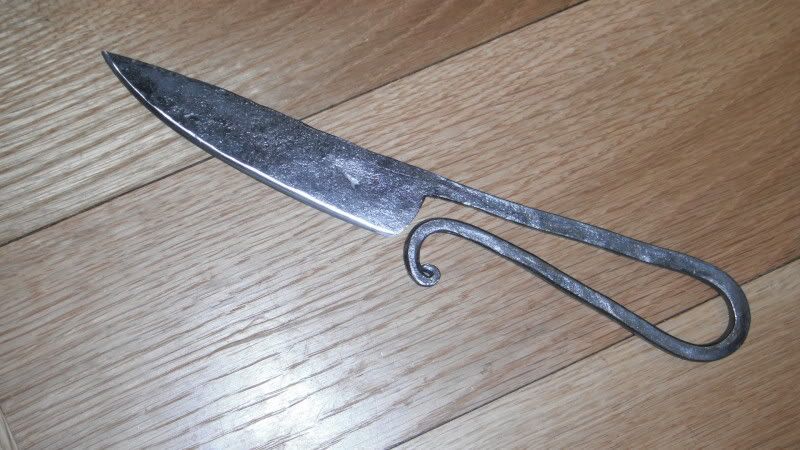
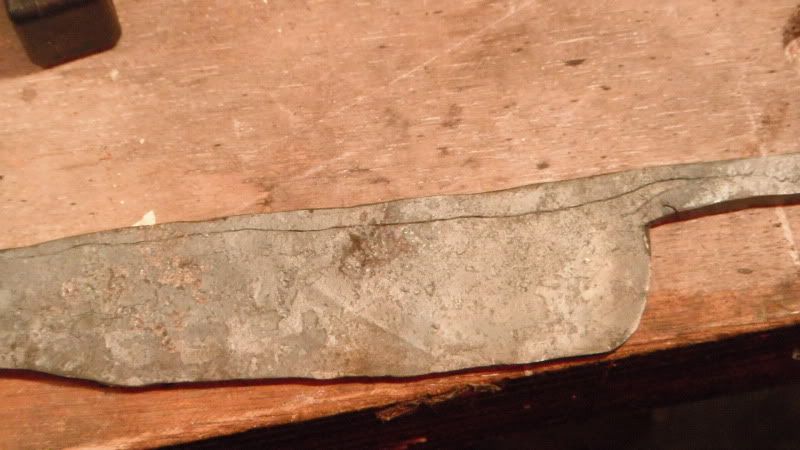
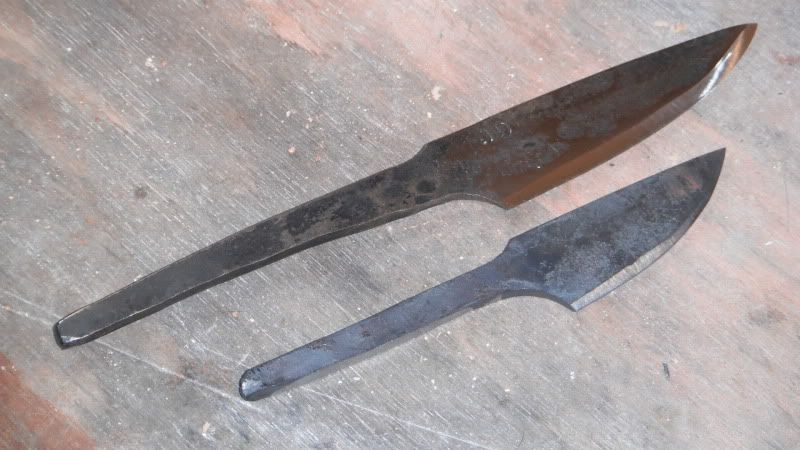
I finally managed to get a fresh bottle of gas for my forge and got around to finishing the viking style knife. It's turned out quite well. I used some piece of re-bar I found and considering it's an unknown bit of steel, and despite having developed some long cracks in the blade and tang, I am very pleased with it.
It's not going to see much service, except in the kitchen, chopping onions and such. The joint betwen the blade and the tang has a crack and it probably would not take much effort to brake the blade off. So it's going to have an easy life.
The blade is about 4 3/4" (120mm) long, overall 9 1/2" long. The only grinding I have done is give a nice curve to the cutting edge and sharpened it, and about 3/4" on the top of the blade at the tip to give it a point. The rest is as forged.
I have learned a lot from making this knife and will apply that new found knowledge to the next ones!
"Not all those who wander are lost."
J R R Tolkien
30 December 2010
24 December 2010
Well, it is Christmas...
....and I would like to wish everyone who visit my blog a happy Xmas and a good New Year.
Although I know it is unlikely to happen, I wil still hope for peace and for people to have more regards & respects for each other's values and lives. And, too, that people learn to love and give more respect to their little planet and all it's inhabitants.
Why the crack...
It is as I suspected. The crack in the viking knife was most likely due to not enough heat. The piece of rebar is really an unknown quality of steel, and there is no way to know what the composition was/is. My little two-brick forge is great for small blades of known quality of steel, such as silver steel and 01. Certainly, nothing much bigger than 4" in length. As well, it didn't help that my bottle of gas started to run on empty...
So, not enough heat from lack of gas, the limitations of the forge, an unknown steel quality, all contributed to the failure of the steel. All good learning opportunities!
I'll still finish the knife, that is, if it does not break before the end of the process. It won't see much active service of course, but it might still be a useful addition to the kitchen!
So, not enough heat from lack of gas, the limitations of the forge, an unknown steel quality, all contributed to the failure of the steel. All good learning opportunities!
I'll still finish the knife, that is, if it does not break before the end of the process. It won't see much active service of course, but it might still be a useful addition to the kitchen!
22 December 2010
Forging a viking knife
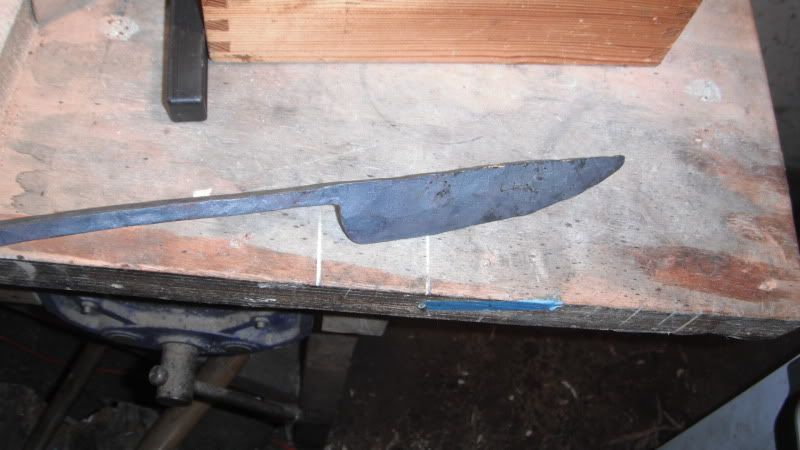
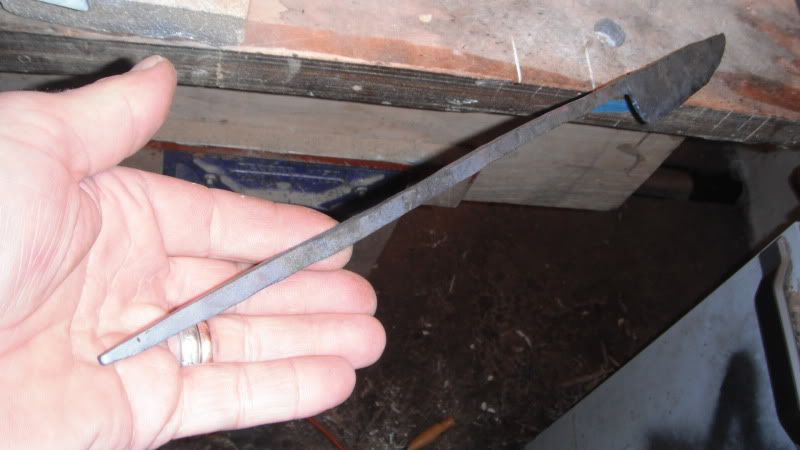
I found a piece of 1/2" (12mm) re-bar today and I started to forge a one piece viking knife. Play was stopped when I ran out of gas...:-(
For now I just have a couple of pictures to show where play stopped!
Now...the not so good bit:
A long crack along the top of the blade and along most of the tang as well...doh! Going from the principle than we often learn more from our mistakes than from what goes well, I am not dissapointed, because this is a learning experiment for me, and I am anxious to discover what caused that crack... Anyone knows? Possibly a mix of not quite enough heat and hitting the steel too hard? I think that the size of this blade may be a little too much for my little gas forge!
I am still going to finish that knife as it's a good exercise in forging.
For now I just have a couple of pictures to show where play stopped!
Now...the not so good bit:
A long crack along the top of the blade and along most of the tang as well...doh! Going from the principle than we often learn more from our mistakes than from what goes well, I am not dissapointed, because this is a learning experiment for me, and I am anxious to discover what caused that crack... Anyone knows? Possibly a mix of not quite enough heat and hitting the steel too hard? I think that the size of this blade may be a little too much for my little gas forge!
I am still going to finish that knife as it's a good exercise in forging.
Touchmark, part two
![]() |
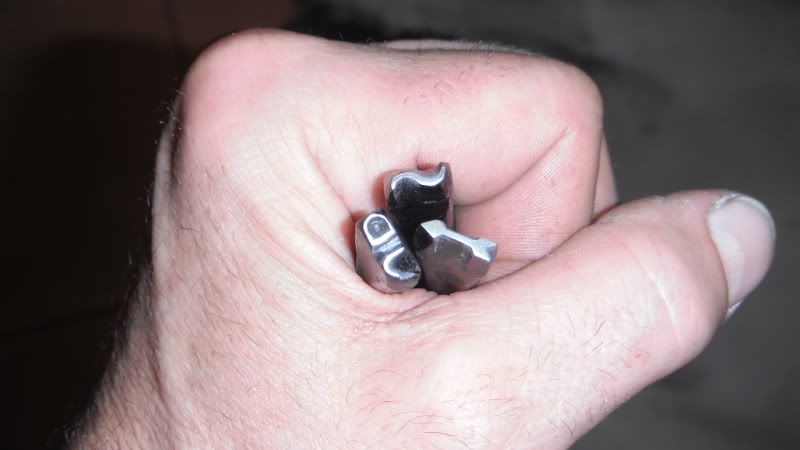
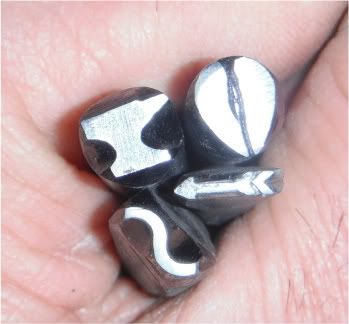
| The three stamps... |
They all can be improved upon and I'll continue to work to improve them, while I try and think up a touchmark design for myself.
![]() |
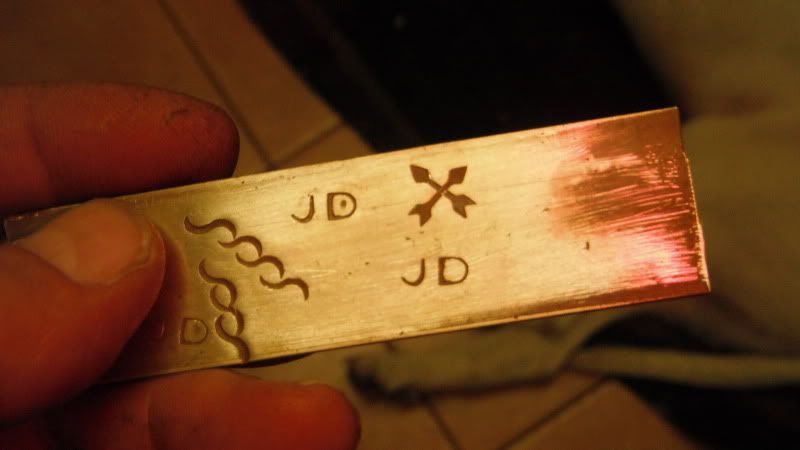
| ...and the marks they makes. |
19 December 2010
Making a blacksmith's touchmark
![]() |
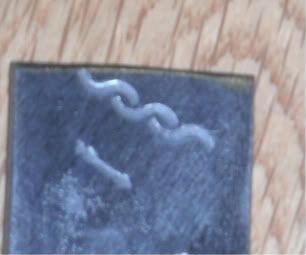
I found out this morning that to have a touckmark make professionally would cost me from £70.00 for a small simple design... So I started thinking that if I can make a knife, I should be able to come up with a suitable mark for my forged knives.I decided to experiment a bit. The steel I used on these tools are small left over silver steel, 1/4" and 3/8".
Some lessons I learned from this experiment.
I now know why they are expensive to make!
I also know its possible to home make a blacksmith's mark, so long as I keep it simple.
The ones that worked best were the squiggly S stamp and the arrow, in that order.
1/4" is too thin, I bent it the second time I hit it.
The stamps should be about 6" long, any shorter and it places your fingers too close to the hot metal you want to stamp.
3/8" should be ok for the thinner marks such as the arrow.
1/2" should be used for the somewhat bigger stamps, because it needs a fairly hefty wallop to make a mark.
So, I am going to experiment some more, and I am fairly confident I can come up with a mark that will suit the style of knives I intend to make in the near future.
![]() |
| A couple of results from the experiment |
14 December 2010
A bit of forging...AKA...hot metal bashing!
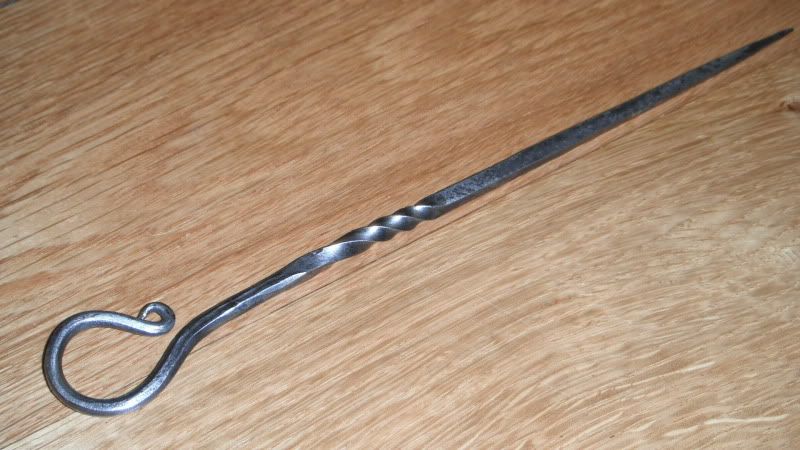
I had a bit of time this afternoon, so I fired my new 2 brick forge and made a couple of things. One is a medieval dining skewer, precursor to the fork as we know it? I followed this picture to make my copy.
Here is mine. It started as a 4 mm square bar of mild steel. The taper is not so easy to get right as it looks. Also, I should have forged the whole length before I twisted the bar, as I think it would have looked better. Getting the round, tapering tail need to do the handle was relatively easy to do. Getting a nice round shape was not as easy either, and I haven't quite succedeed. But all in all though, I am very pleased with it
What I am trying for is to get the feel for manipulating the metal. It is quite different from working wood, which is within my comfort zone: what you do is to remove material. Same with stock removal. . Forging is more intuitive I believe. you need to learn through your hammer what it feels like, where the metal is moving to, because, with wood, you remove material. With forging hot metal, you displace mass. I made this skewer to get the feel for making a long taper. Also to get the feel of how the hot metal moves when you make a round out of a square.
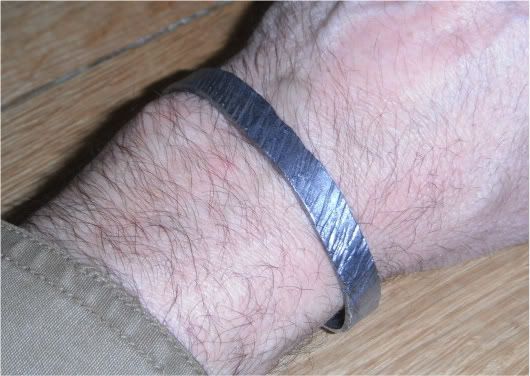
The other object I made is this wrist band. On the face of it, a simple shape. But it's not that easy to get that simple shape! I started from a 4mm square mild steel from the local DIY shop I had kicking about. I am quite pleased with this one as well. I'll be wearing it for now!
I am really enjoying forging, and will be making more small objects as practice. Next will probably be a try at a two prong fork. There is a lot to learn!
Here is mine. It started as a 4 mm square bar of mild steel. The taper is not so easy to get right as it looks. Also, I should have forged the whole length before I twisted the bar, as I think it would have looked better. Getting the round, tapering tail need to do the handle was relatively easy to do. Getting a nice round shape was not as easy either, and I haven't quite succedeed. But all in all though, I am very pleased with it
What I am trying for is to get the feel for manipulating the metal. It is quite different from working wood, which is within my comfort zone: what you do is to remove material. Same with stock removal. . Forging is more intuitive I believe. you need to learn through your hammer what it feels like, where the metal is moving to, because, with wood, you remove material. With forging hot metal, you displace mass. I made this skewer to get the feel for making a long taper. Also to get the feel of how the hot metal moves when you make a round out of a square.
The other object I made is this wrist band. On the face of it, a simple shape. But it's not that easy to get that simple shape! I started from a 4mm square mild steel from the local DIY shop I had kicking about. I am quite pleased with this one as well. I'll be wearing it for now!I am really enjoying forging, and will be making more small objects as practice. Next will probably be a try at a two prong fork. There is a lot to learn!
12 December 2010
Knife Raffle for the benefit of The Big Issue Foundation
In order to help my daughter achieve her goal of raising £1300 for The Big Issue, and therefore be able to take part on the London to Paris 2011 Bike Ride, I am holding two raffles for two of my handmade knives at the same time on two different forums: on Bushcraftuk and on Planet Bushcraft . Both owners have very kindly agreed to let me hold the raffles on their forums. For this, I'd like to offer my thanks to them.
8 December 2010
The two new knives
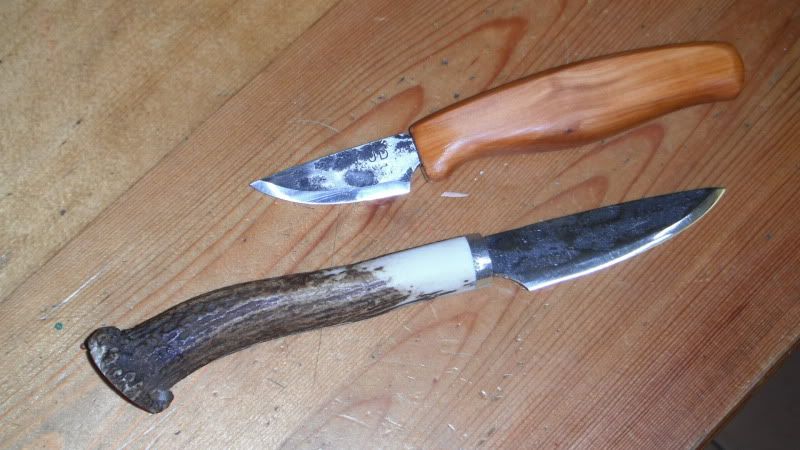
This is a picture of the two knives I have made with the blades I forged a couple of days ago.
The smaller one has a handle of Yew, dipped into Linseed oil. It's a little whittling knife for a young man's Christmas present.
The larger one has a deer antler and pewter handle it still need a bit of finishing work and then, both want a sheath, of course.
The smaller one has a handle of Yew, dipped into Linseed oil. It's a little whittling knife for a young man's Christmas present.
The larger one has a deer antler and pewter handle it still need a bit of finishing work and then, both want a sheath, of course.
7 December 2010
My new two brick gas forge
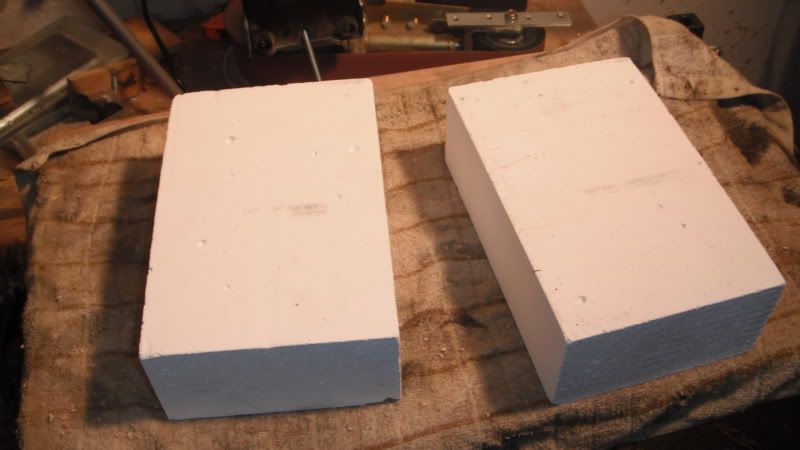
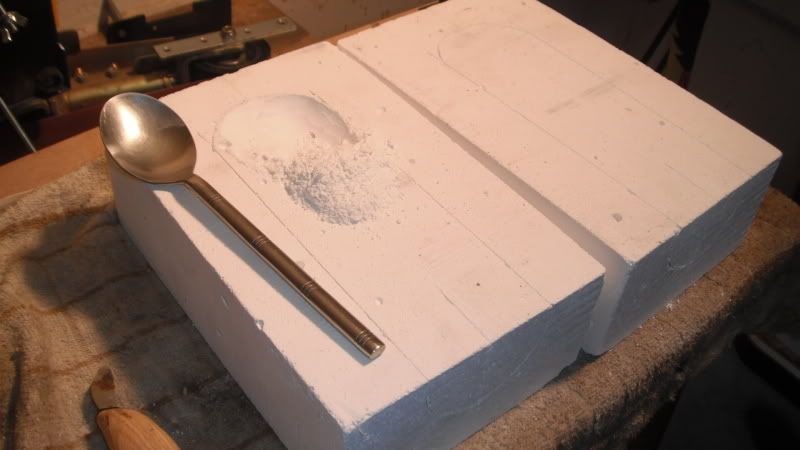
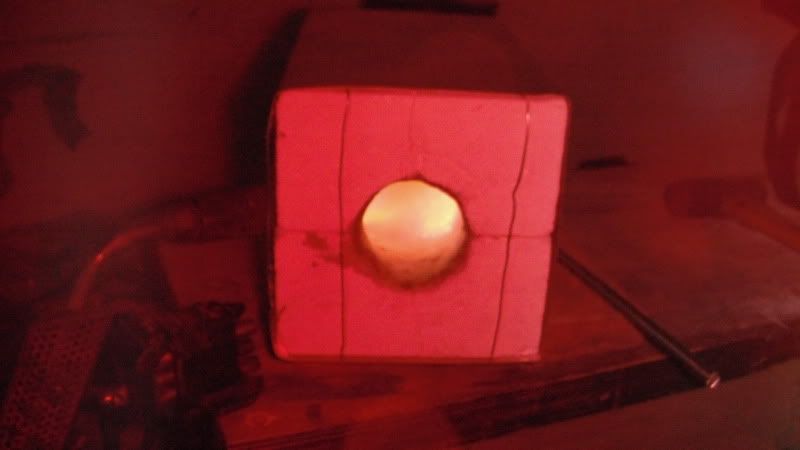
I finally got around to making my new small, 2 brick gas forge. I used some Insulation Bricks, 23GD - 230 x 152 x 76mm, so they are a bit bigger than ordinary bricks. It's easier to do the work in two halves, because you can carve the 1/2 chambers out much more easily. I used a spoon, as the bricks are quite soft, and used a rasp to finish. My blow torch is not a beast by any means, but it does the job well enough. The fire cement has not cracked at all, so far anyway, but the bricks have developed a few cracks. I don't think they are much of a problem though.

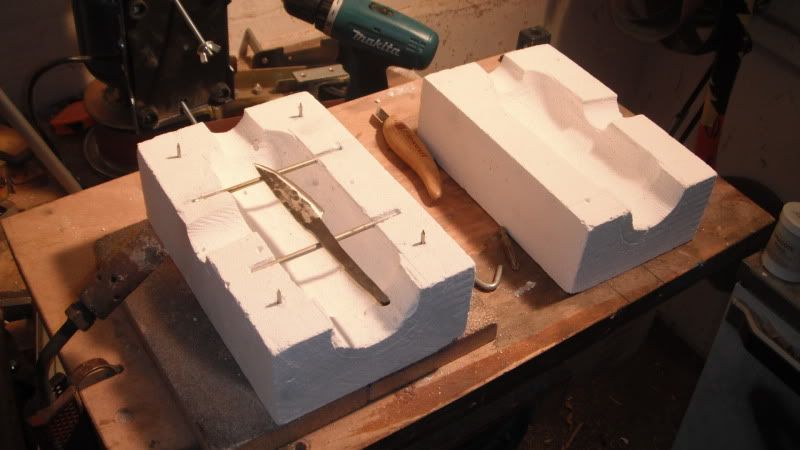
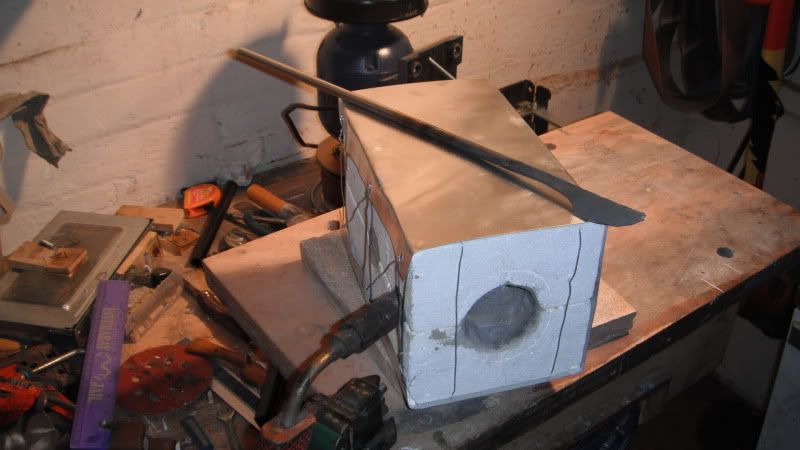
Once carved, both halves of the chamber are lined with refractory cement, then attached together, simply by using garden wire. I also removed the two bars across the chamber. The joints between both bricks received some refractory cement, that was a bit more difficult due to the relative narrowness of the chamber, but not too bad. Then I folded a sheet of aluminium around it to protect the soft bricks.
Once finished, I put the whole caboodle into the cooker's oven for a couple of hours to cure the cement. I fired it today and forged a couple of blades out of some 3/8" Silver Steel . So far, I am very pleased with it: it gives out plenty of heat for small blades and I can use it inside my workshop, with the door open of course! Until I can come up with a more imaginative maker's mark, I'll be stamping my initials JD on the blades.
I did a bit of file work to tidy up both blades, as my forging is still in its enfancy. I have put the whole thing on top of some more reflactory bricks, to prevent any risk of scorching the bench. The outside of the forge does get warm but not too badly so there shouldn't be any problems.

Once carved, both halves of the chamber are lined with refractory cement, then attached together, simply by using garden wire. I also removed the two bars across the chamber. The joints between both bricks received some refractory cement, that was a bit more difficult due to the relative narrowness of the chamber, but not too bad. Then I folded a sheet of aluminium around it to protect the soft bricks.
![]() |
| The blades are 3" and 2" long |
A short walk by the river
![]() |
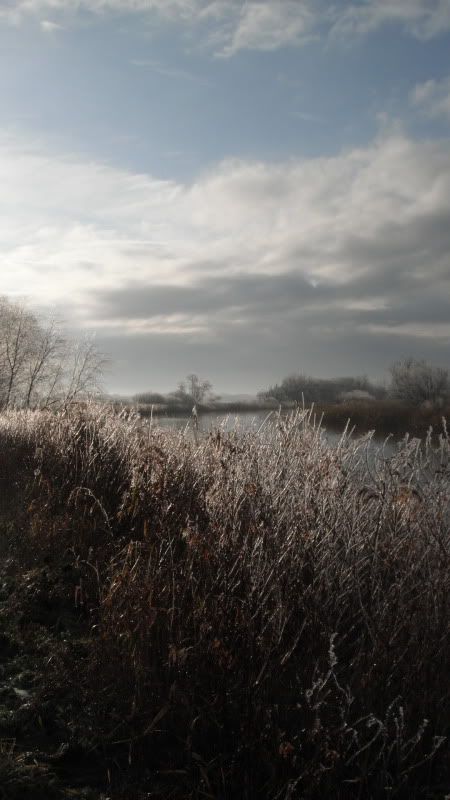
| Ice on the trees and reeds along the Waveney River |
![]() | |||
| One of the many drainage dikes |
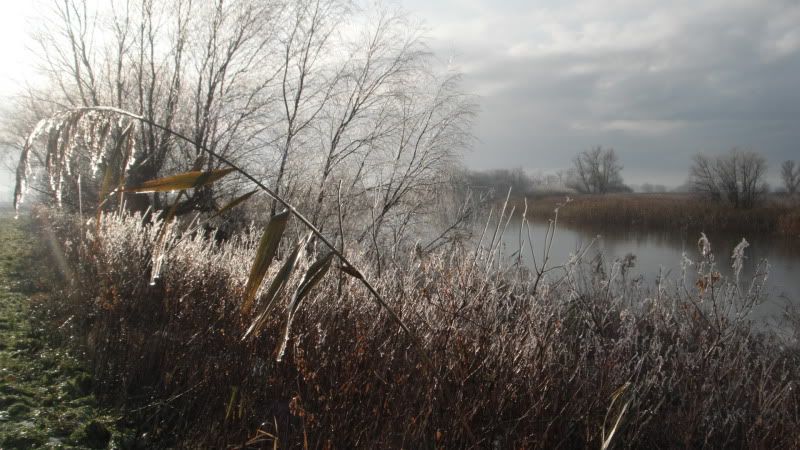
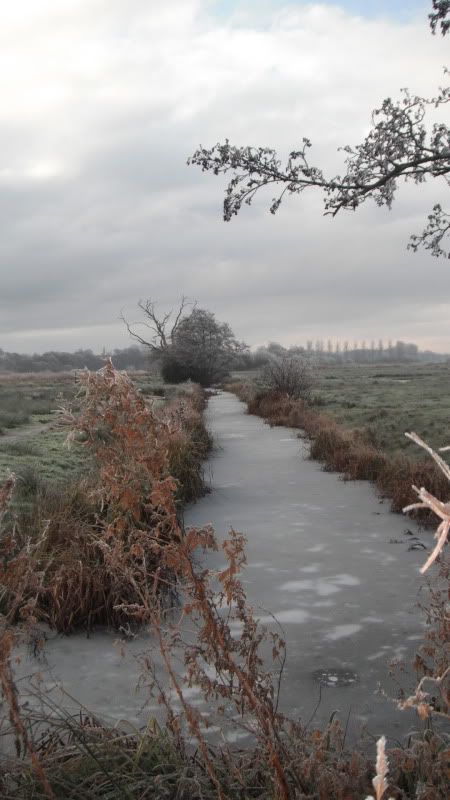
This morning, I saw Herons, a Barn Owl working the edge of the banks along the river, swans, I even got a glimpse of what I think was a Weasel, scuttling across the path.
![]() |
| The Waveney River, looking South |
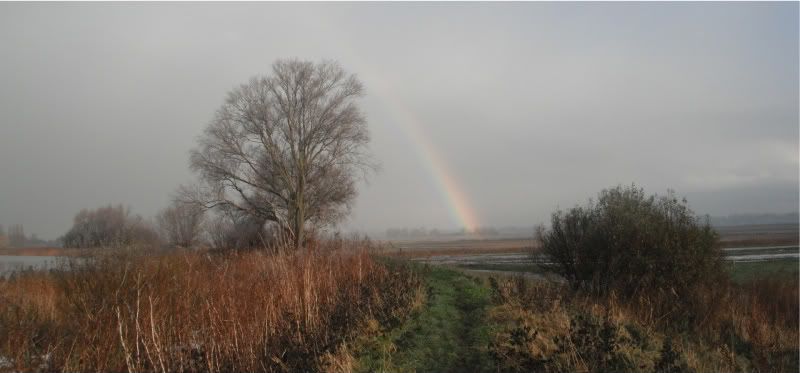
![]() |
| Rainbow, looking North |
Unfortunately, we can't see it, but the deer was grazing in the field, right under the bottom of the rainbow!
![]() |
| Not a terribly good picture of the swan! |
![]() |
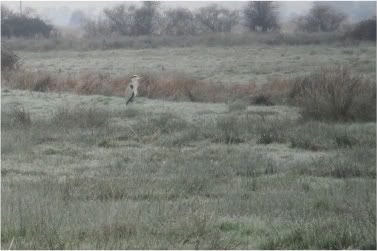
| One of the many herons on the marshes |
4 December 2010
What is a crooked Knife?
There are many different type of carving knives with curved blades. People seem to call anything with a curved blade a crooked knife.
The proper Crooked Knife or, to give it it's Native American names, the Wagikoman, Mocotaugan, Mukutakan, Bikahtagenigan, Couteau Croche, appear to have originally been a Native American tool made using beaver teeth and, most probably other material such as stones. Later, when white people turned up uninvited, taking over the show and bringing many unwanted things, they also brought steel with them. Presumably because steel is stronger than beaver's teeth, (I assume, having never used a beaver's tooth, to make a knife, I wouldn't mind trying to make one, if someone out there has any beaver's teeth to spare!) the crooked knives acquired steel blades.
Depending on what you read, the word crooked refers to the shape of the handle rather than the blade, but other texts assert the name refers to the shape of the blade and not to the handle.
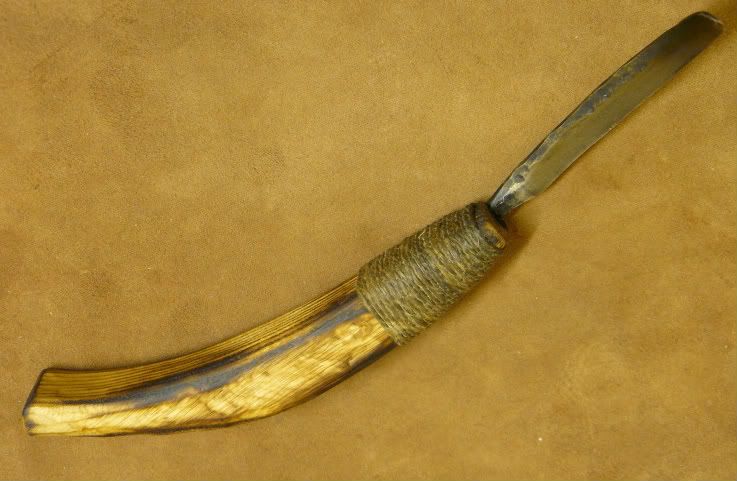
So to me, a Mocotoguan is a tool like this:
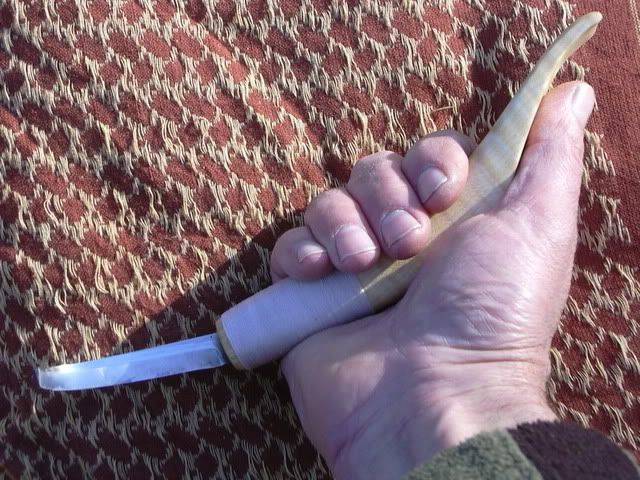
And you hold it like this:
Apart from an ushtashku (axe), one can think of no other tool as important to the Innu hunter as the mukutakan (crooked knife). This multi-purpose knife was used to shave thin planking and ribs for canoes and toboggans, make stretching boards to dry furs, carve wooden dolls for the children, fashion snowshoe frames and drums, and many other objects out of wood...
Another of the characteristics of this tool is that you pull it towards you, rather than pushing it away from you. It is more akin to using a draw knife, albeit a one-handed one. Native Woodsmen didn't carry a bench or a vice in the woods with them, so they held the piece to be worked in one hand and then held the knife in the other hand. A obsession with Health & Safety has conditioned people to worry about pulling a sharp blade towards themselves, in fear of cutting themselves open. If you hold the Mocotogan correctly, hold your elbow against your side and work green wood as was intented, there is no more reason to cut yourself than with any other tools.
The blades can be many shapes and sizes, from a straight blade, sticking straight out of the handle, to a curved blade with compound angles . From my own experience, the curve at the end of the blade is there more to prevent digging into the work with the tip rather than to be used for hollowing . It can be used for hollowing, but I don't think this was the entended purpose for the majority of the knives. Again from my own experience, I believe the blades need to be thick enough not to bend.
Other curved blade knives.
There are other curved knife blades available, and I have seen most of them called crooked knives, though they definitely are not.
Then, there are the carving blades made by Kestrel Tools. These are high quality, I would almost say dainty, carving tools blades. They are carving knives blades rather than crooked knives.
Of course, a crooked knife is a very versatile tool. It's not just wood you can use it on!
In my view then, it's horse for courses . Spoon knives for hollowing, curved carving blades for carving, hoof and loop knives for horses' feet.
So, in my (not humble or apologetic at all!) opinion the Crooked knife is, and deserves to be the true, versatile, Bushcraft knife.
The proper Crooked Knife or, to give it it's Native American names, the Wagikoman, Mocotaugan, Mukutakan, Bikahtagenigan, Couteau Croche, appear to have originally been a Native American tool made using beaver teeth and, most probably other material such as stones. Later, when white people turned up uninvited, taking over the show and bringing many unwanted things, they also brought steel with them. Presumably because steel is stronger than beaver's teeth, (I assume, having never used a beaver's tooth, to make a knife, I wouldn't mind trying to make one, if someone out there has any beaver's teeth to spare!) the crooked knives acquired steel blades.
Depending on what you read, the word crooked refers to the shape of the handle rather than the blade, but other texts assert the name refers to the shape of the blade and not to the handle.
So to me, a Mocotoguan is a tool like this:
![]() |
| Mocotoguan with forged blade |
And you hold it like this:
![]() |
| Holding a right-handed crooked knife |
It is a very versatile tool, and was used primarily to work green woods, rather than dry woods.
![]() |
| Using the crooked knife |
The blades can be many shapes and sizes, from a straight blade, sticking straight out of the handle, to a curved blade with compound angles . From my own experience, the curve at the end of the blade is there more to prevent digging into the work with the tip rather than to be used for hollowing . It can be used for hollowing, but I don't think this was the entended purpose for the majority of the knives. Again from my own experience, I believe the blades need to be thick enough not to bend.
Other curved blade knives.
There are other curved knife blades available, and I have seen most of them called crooked knives, though they definitely are not.
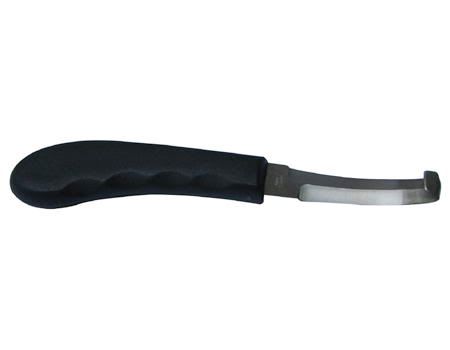
![]() |
| Hoof knife, as used by farriers |
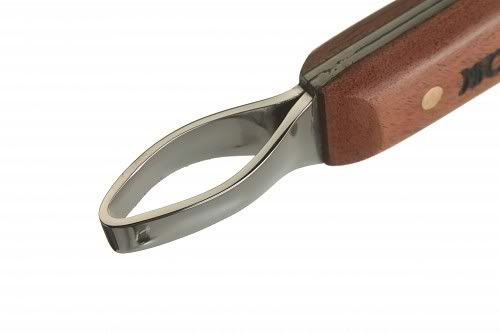
![]() | ||
| Loop knife |
![]() | |||||||||||||||||||||||||||
| The good old Mora spoon knife |
Then, there are the carving blades made by Kestrel Tools. These are high quality, I would almost say dainty, carving tools blades. They are carving knives blades rather than crooked knives.
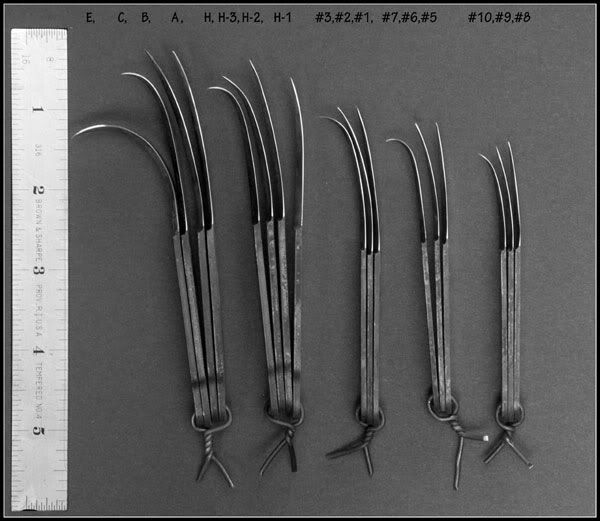
![]() |
| Complete set of Kestrel's carving blades |
Of course, a crooked knife is a very versatile tool. It's not just wood you can use it on!
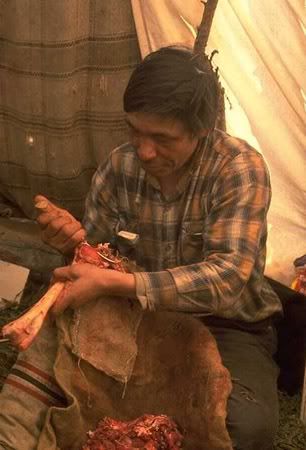
![]() |
| Removing meat from a bone |
In my view then, it's horse for courses . Spoon knives for hollowing, curved carving blades for carving, hoof and loop knives for horses' feet.
So then, crooked knife for all purpose green wood work, or for dry softwood.
So, in my (not humble or apologetic at all!) opinion the Crooked knife is, and deserves to be the true, versatile, Bushcraft knife.
2 December 2010
The Village Blacksmith
Under a spreading chestnut-tree The village smithy stands; The smith, a mighty man is he, With large and sinewy hands; And the muscles of his brawny arms Are strong as iron bands. His hair is crisp, and black, and long, His face is like the tan; His brow is wet with honest sweat, He earns whate'er he can, And looks the whole world in the face, For he owes not any man. Week in, week out, from morn till night, You can hear his bellows blow; You can hear him swing his heavy sledge, With measured beat and slow, Like a sexton ringing the village bell, When the evening sun is low. And children coming home from school Look in at the open door; They love to see the flaming forge, And hear the bellows roar, And catch the burning sparks that fly Like chaff from a threshing-floor. He goes on Sunday to the church, And sits among his boys; He hears the parson pray and preach, He hears his daughter's voice, Singing in the village choir, And it makes his heart rejoice. It sounds to him like her mother's voice, Singing in Paradise! He needs must think of her once more, How in the grave she lies; And with his haul, rough hand he wipes A tear out of his eyes. Toiling,--rejoicing,--sorrowing, Onward through life he goes; Each morning sees some task begin, Each evening sees it close Something attempted, something done, Has earned a night's repose. Thanks, thanks to thee, my worthy friend, For the lesson thou hast taught! Thus at the flaming forge of life Our fortunes must be wrought; Thus on its sounding anvil shaped Each burning deed and thought.
Henry Wadsworth Longfellow
Canoe at the Victoria & Albert Museum in London???
I recently received this very interesting Email from a researcher from the V&A Museum in London.
Dear Mr Delorme
I am currently conducting research on behalf of the Victoria & Albert
Museum, London, for a forthcoming show slated for Sept 2011 about
skills and making. At this stage of our reseach, we would like to
inquire about the availability of one of your bespoke canoes found
through: http://www.birchcanoes.com/bespoke.htm
Could you please let us know what the availability of the piece is --
is there one already built , for example. It would be great if you
could also share with us some basic object information such as
dimenions, materials used and weightage.
Many thanks for your help with this. Please do not hesitate to contact
me if you have any questions at this time.
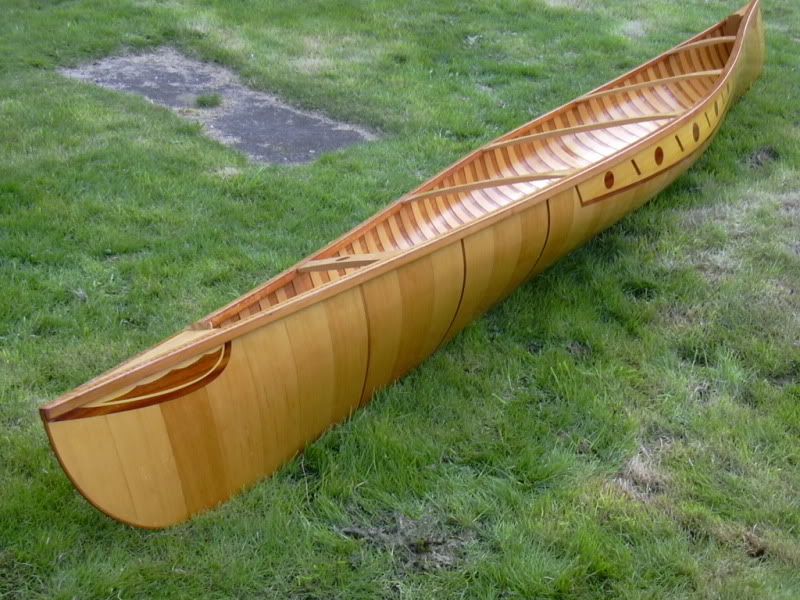
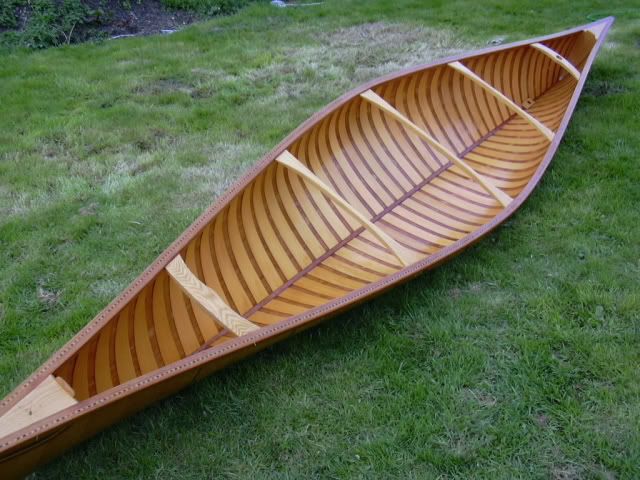
The canoe in question is this one. I built it a few years ago now.
I am really pleased my work interested the researcher enough that it might be part of a show at the V&A !
I hope something will come out of this.
Dear Mr Delorme
I am currently conducting research on behalf of the Victoria & Albert
Museum, London, for a forthcoming show slated for Sept 2011 about
skills and making. At this stage of our reseach, we would like to
inquire about the availability of one of your bespoke canoes found
through: http://www.birchcanoes.com/bespoke.htm
Could you please let us know what the availability of the piece is --
is there one already built , for example. It would be great if you
could also share with us some basic object information such as
dimenions, materials used and weightage.
Many thanks for your help with this. Please do not hesitate to contact
me if you have any questions at this time.
The canoe in question is this one. I built it a few years ago now.
I am really pleased my work interested the researcher enough that it might be part of a show at the V&A !
I hope something will come out of this.
Subscribe to:
Posts (Atom)