This is going to be a small rant, but I feel I need to have it..:-(((
What is it with people...
I went into the local Tesco Express earlier, having run out of milk and coffee. Got to my turn to pay, I rummaged a bit in my pocket for change and found I was short of 40p, so I had to get my card out. Now how long do you think this all took? 20/30 seconds ? The look of exasperation on Grumpy's face (that's the name of the guy at the till now), because I obviously was taking far too much of his time. You'd think I was taking half his day with my transaction....Maybe I am old fashion now. It's not cool to be polite, let alone pleasant, for a shop worker it seems. In most shops, you get bored, grumpy, unpleasant people serving you. And it was not just Grumpy who was grumpy looking. The woman behind me had the same exasperated look on her face when I turned around, and made no effort to let me pass, she had to in the end but really...Maybe I am just a "past it" ol'codger.. But at least I do my best to be pleasant to people.
"Not all those who wander are lost."
J R R Tolkien
27 November 2010
23 November 2010
Carving knives
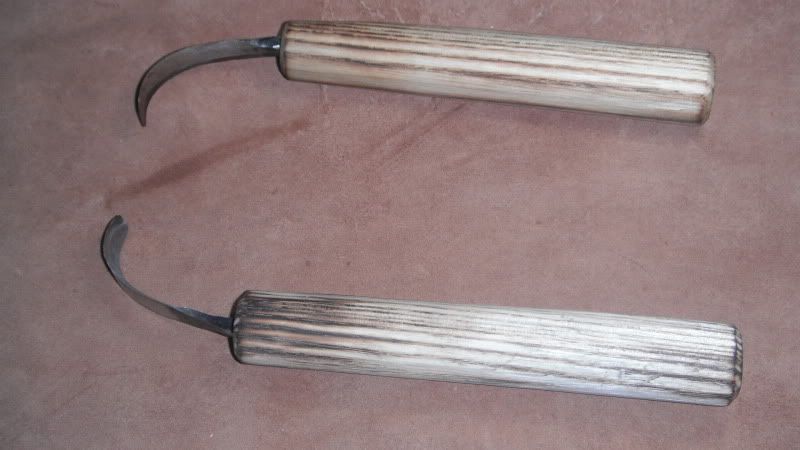
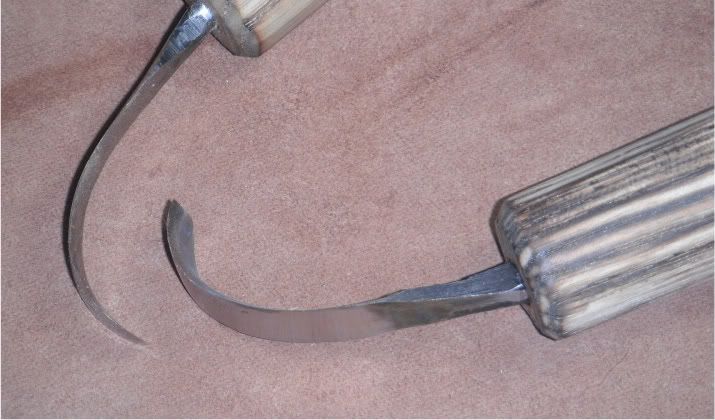
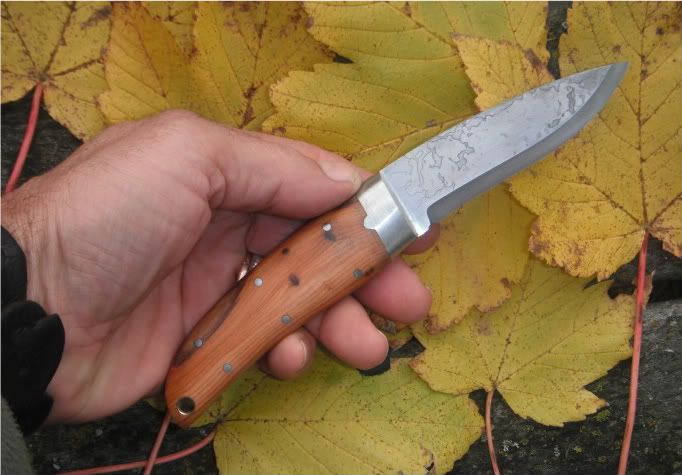
About 2 weeks ago, I posted about a small spoon carving knife I had made with a forged silver steel blade. I have now replaced the handle for something longer and simpler. Also, I have forged a few more blades, both left and right handed ones. Here are a couple of pictures of one left handed and one right handed blades.The handles are hand carved Ash, slightly burned with a blow torch to give them a bit of character, then oiled with Linseed oil. The blades are epoxied into a hole in the handle. The holes are drilled at an angle into the handle to give the blade a slight up and back sweep.
I am going to forge some more of those carving blades, with different curves on them, from flatter curves to some with tighter curves. Watch this space!
I forgot to say, I used some 1/4" (6mm) round silver steel bar for those blades.
22 November 2010
Simple design for a crooked knife
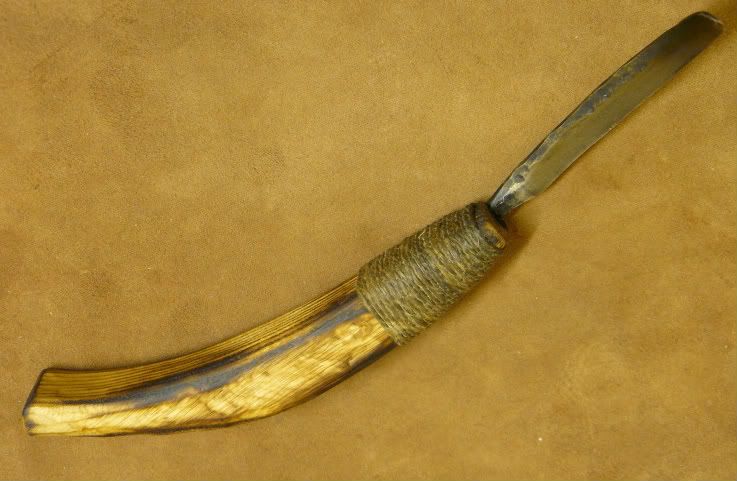
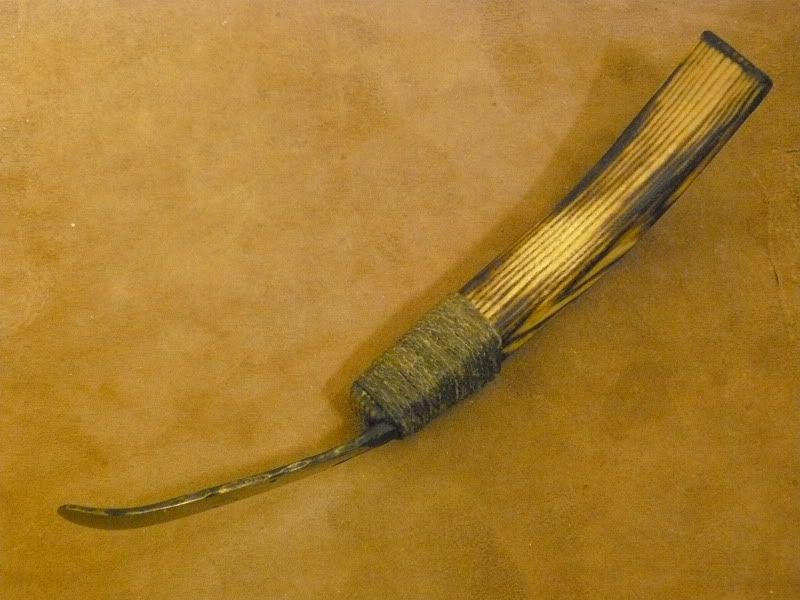
I made this simple left handed crooked knife yesterday, the blade is forged from a 1/4" silver steel round bar. It has a slight curve along its length with a more upsweep curve at the end. The purpose of that upsweep is to prevent the tip of the blade from digging in when you want to carve a flat surface such as a paddle blade, not to carve hollows such as spoons or kuksas. The blade has both a upsweep angle and a backward angle, the purpose of these being to make it easier to keep the wrist in line with the forearm, therefore making it easier and less tiring to carve with
it. The handle is a simple piece of Oak, curved to suit my hand in this case, then carved with a knife, singed with a blow torch ans lightly sanded. The blade, which has a 90 degrees point at the end of the tang, is fitted into a groove in the handle and glued with pitch pine, wrapped with some thick rough linen thread which is then saturated with melted beeswax.
The whole handle is then coated with beeswax too. Using a heat gun made it easy to saturate the thread and the handle.
I like to think that Wallace McLean would have approved!
it. The handle is a simple piece of Oak, curved to suit my hand in this case, then carved with a knife, singed with a blow torch ans lightly sanded. The blade, which has a 90 degrees point at the end of the tang, is fitted into a groove in the handle and glued with pitch pine, wrapped with some thick rough linen thread which is then saturated with melted beeswax.
The whole handle is then coated with beeswax too. Using a heat gun made it easy to saturate the thread and the handle.
I like to think that Wallace McLean would have approved!
A viking sheath
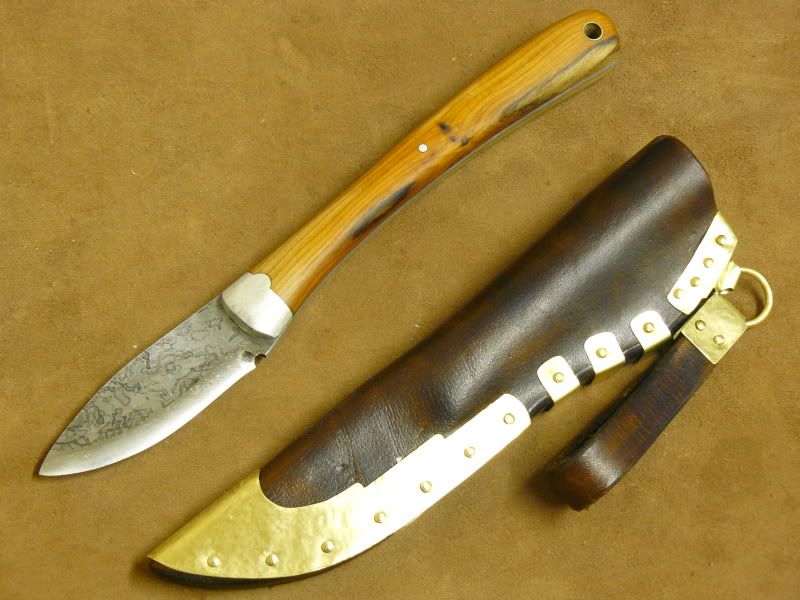
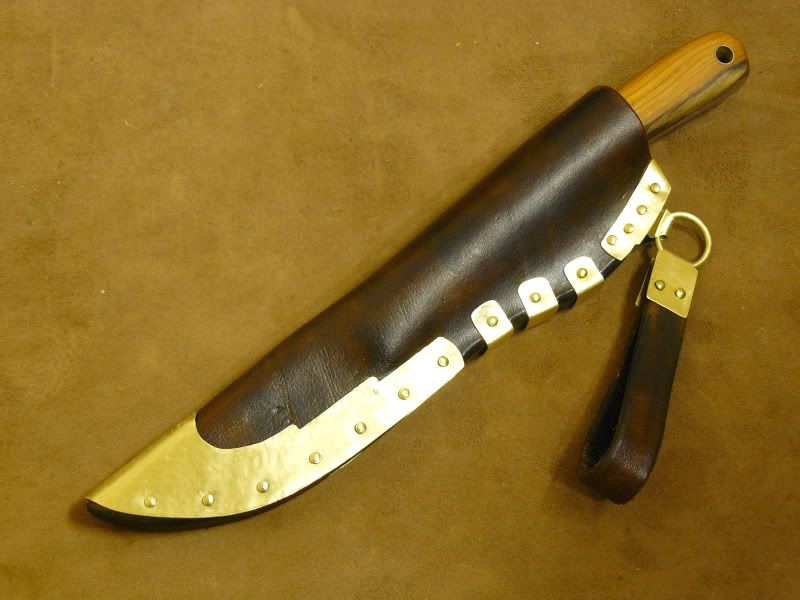
I have thought before about making a copy of one of those viking sheath, and so when I finished my knife with the long handle I thought that the viking style would go quite well with it.
The leather part of the sheath is quite conventional, with a welt glued in. I did not do any sewing on this sheath. The brass fittings are all cut from some thinnish brass plate I got from a model shop. The rivets are round headed brass nails. I made some thin cardboard patterns for all the pieces before cutting them, card being easier to work without damaging the leather surface and dye. The hardest part of making this sheath was drilling the rivet holes square to the sheath so they would come out at the right place on the other side of the sheath. It proved easier to drill through half way, then turn the sheath around and drill from the other side.The surface of the brass fittings are hammered lightly with a bronze peen hammer to give a slight texture which I think contrast very nicely with the texture and colour of the leather.
I loosely copied the design of the brass fittings, and modifed them to suit the shape of the knife to ensure a good tight fit.
21 November 2010
How to make a crooked knife
I was doing a bit of searching for crooked knives and found this interesting short article by a chap called Wallace McLean.
The crooked knife I got is an old one that I got from an old Indian feller a long time ago. I made one myself about five years ago.
A lot of people, when they makes a crooked knife, got to have a certain kind of wood to make their fire burn. Some says it got to be birch. Some says it got to be balsam. Me, I don't care what it is.

Crooked Knife by Wallace McLean
You take a set of knives or a bunch of axes, they all look alike, but you get some good ones and some bad ones. 'Tis the same with crooked knives. My one, I made out of an old trap spring, which is the best steel you can get. You might make one that will turn out number one, and you might make a dozen and not get a good one among them.
First you got to take the temper out of the steel. What I do is this. I red hot the steel and cut it to shape with a file. Once you burn the temper out it becomes easy to cut, so then you files it down to the shape you wants. When 'tis finished you heat it up again. Now you dip it in salt water, weak pickle. When you take it out of the pickle, you run your file over it. If the file won't take hold, well, 'tis too hard, and if the file digs in, then 'tis too soft. If 'tis too hard you heat it up on the stove until the file will take hold to your likin'. If 'tis too soft you heat it again and put it back in the pickle.

Wallace McLean
You file a crooked knife on one side. A crooked knife, a plane and a draw-knife is only bevelled on one side.
What I can't do with a crooked knife I can't do at all. The crooked knife is the most tool I ever used in my life. There's lots of people who don't know how to use a crooked knife. I've seen people use them upside down. You can't use it like that. If I was goin' to make a shavin' with a pocket knife. I'd cut away from me. If I was makin' a shavin' with a crooked knife, I'd cut towards me. That's how 'tis done.
WALLACE McLEAN
NORTH WEST RIVER
THEM DAYS VOL. 5.1
The crooked knife I got is an old one that I got from an old Indian feller a long time ago. I made one myself about five years ago.
A lot of people, when they makes a crooked knife, got to have a certain kind of wood to make their fire burn. Some says it got to be birch. Some says it got to be balsam. Me, I don't care what it is.

Crooked Knife by Wallace McLean
You take a set of knives or a bunch of axes, they all look alike, but you get some good ones and some bad ones. 'Tis the same with crooked knives. My one, I made out of an old trap spring, which is the best steel you can get. You might make one that will turn out number one, and you might make a dozen and not get a good one among them.
First you got to take the temper out of the steel. What I do is this. I red hot the steel and cut it to shape with a file. Once you burn the temper out it becomes easy to cut, so then you files it down to the shape you wants. When 'tis finished you heat it up again. Now you dip it in salt water, weak pickle. When you take it out of the pickle, you run your file over it. If the file won't take hold, well, 'tis too hard, and if the file digs in, then 'tis too soft. If 'tis too hard you heat it up on the stove until the file will take hold to your likin'. If 'tis too soft you heat it again and put it back in the pickle.

Wallace McLean
You file a crooked knife on one side. A crooked knife, a plane and a draw-knife is only bevelled on one side.
What I can't do with a crooked knife I can't do at all. The crooked knife is the most tool I ever used in my life. There's lots of people who don't know how to use a crooked knife. I've seen people use them upside down. You can't use it like that. If I was goin' to make a shavin' with a pocket knife. I'd cut away from me. If I was makin' a shavin' with a crooked knife, I'd cut towards me. That's how 'tis done.
WALLACE McLEAN
NORTH WEST RIVER
THEM DAYS VOL. 5.1
19 November 2010
London to Paris Bike Ride
No doubt you noticed the large Logo about this. Well, my daughter has signed up to do this ride on behalf of the Big Issue Foundation. 230 miles in 3 days, one of the days will be 90 miles! Now, I sometimes cycle the 10 miles to where I work. It takes me about an hour. So 90 miles would take me about 9 hours +... I am certain my daughter is fitter than I am! Still, it's not an easy thing to do and no doubt she will be saddle sore by the end of the day.
She has to raise the sponsorship money herself, plus all the equipment she'll need. She would appreciate any support you can give her, particularly money, so she can achieve the goal to raise the money for the Big Issue, and in the process, to achieve her personal goal to cycle to Paris!
Thank you for any help.
She has to raise the sponsorship money herself, plus all the equipment she'll need. She would appreciate any support you can give her, particularly money, so she can achieve the goal to raise the money for the Big Issue, and in the process, to achieve her personal goal to cycle to Paris!
Thank you for any help.
My blog's evolving!
The eagle-eyed among you may have noticed a few changes on my blog recently. From the picture at the top, to the addition of a definition of what I think my blog is about, to a different colour scheme.
I have been pondering about what my blog is about and came to the conclusion that I was not clear, even to myself, where I was going with it. So far it's been mainly "about" the things I make. Mainly knives of course, after all, I am now trying to make and sell them to supplement my income, so this is part of a proper business. So it is important for me to continue talking about my newest designs. Of course, I am not giving up the day job just yet! I am not making a fortune here...
However important making things is to me, there is more to life. There is also the why and the how, and I would like to give back a bit more by showing how I makethose objects. So I'll be making some more video tutorials and write more about how I make knives and other artifacts.
I have noticed too that I have done more Ramblings than Wanderings. So, I'll be adding more of those in the near future. I'll be doing/showing a bit more bushcraft and carving than I have done recently too.
If anyone has suggestions about what they'd like to see here, I would appreciate if you would please post some comments here.
I have been pondering about what my blog is about and came to the conclusion that I was not clear, even to myself, where I was going with it. So far it's been mainly "about" the things I make. Mainly knives of course, after all, I am now trying to make and sell them to supplement my income, so this is part of a proper business. So it is important for me to continue talking about my newest designs. Of course, I am not giving up the day job just yet! I am not making a fortune here...
However important making things is to me, there is more to life. There is also the why and the how, and I would like to give back a bit more by showing how I makethose objects. So I'll be making some more video tutorials and write more about how I make knives and other artifacts.
I have noticed too that I have done more Ramblings than Wanderings. So, I'll be adding more of those in the near future. I'll be doing/showing a bit more bushcraft and carving than I have done recently too.
If anyone has suggestions about what they'd like to see here, I would appreciate if you would please post some comments here.
16 November 2010
My latest knife. The Kestrel
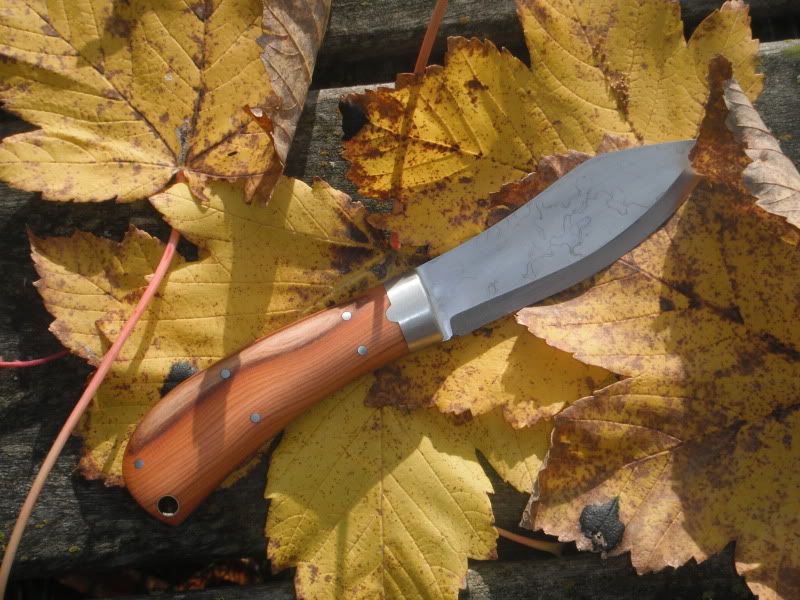
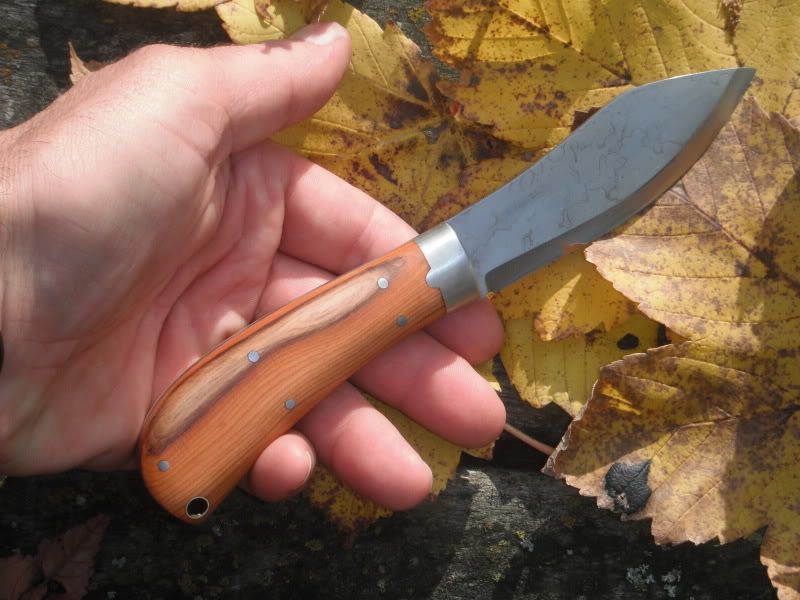
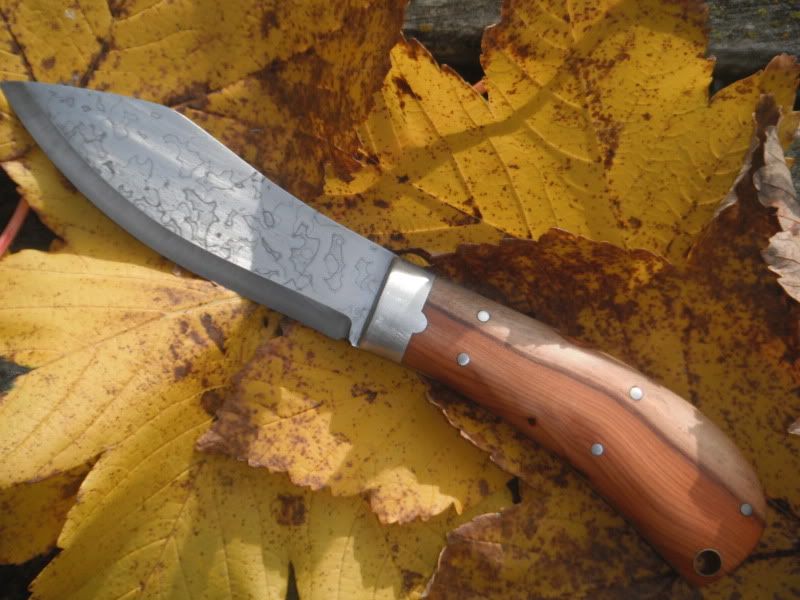
This is my latest knife and I called it the Kestrel. As all my stock removal knives, I have used 3mm thick 01 tool steel stock for the full tang blade. It is just 8" long and the cutting edge of the blade is 3 3/4" long with a blade width of 1". I have used a nice piece of English Yew for the scales and once again poured a pewter bolster. The scales are epoxied to the blade and I used some steel pins as well. The handle needs a little more sanding and soaking in boiled Linseed oil to finish. I have made the handle a little chunky and, with the added weight of the pewter bolster, the Kestrel feels like quite a solid knife.
The pictures are slightly blurred but I have now purchased a tripod so I am hoping my photography will improve!

The pictures are slightly blurred but I have now purchased a tripod so I am hoping my photography will improve!

10 November 2010
Carving a spoon. Part one
This is my first venture into making short videos, but I'll be making more short videos to show how I carve a spoon. Apart from cutting the blank on the band saw to save timber, I'll try to only use that curved carving tool. I haven't got a plan as to what the spoon will look like when it's done, and I hope it will prove interesting to a few people.
So, here goes...
So, here goes...
New spoon carving tool
I decided to fire up my little gas "forge" yesterday. Well, forge is a rather grand name for a few fire bricks held together with fencing wire, but it work well enough for small stuff!
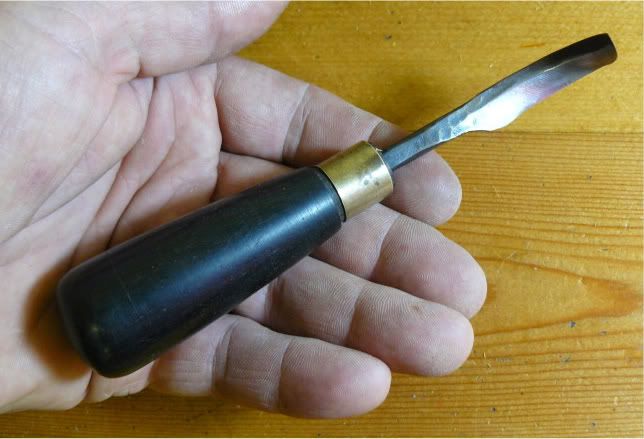
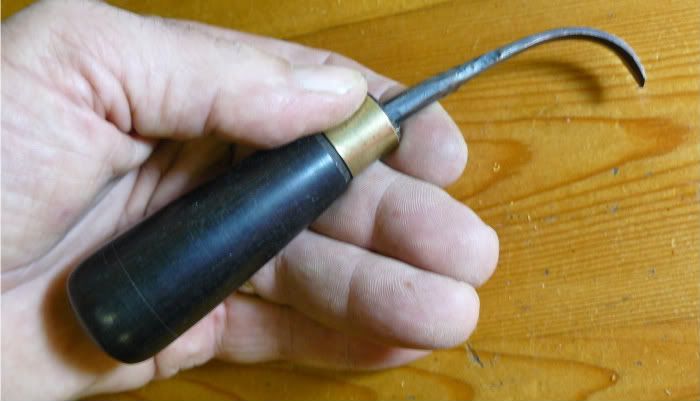
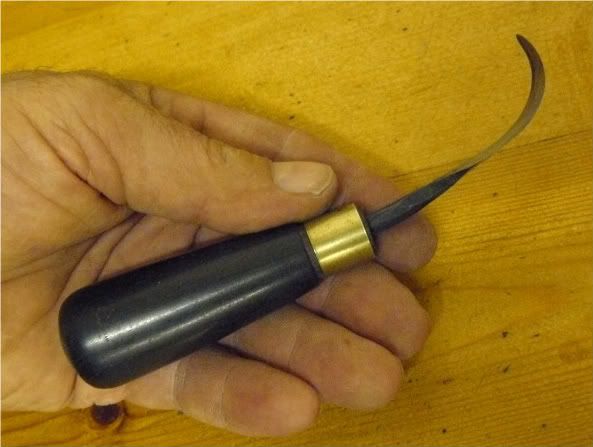
Not feeling up to big works at the moment, I have been thinking about small carving tools, such as spoon knives and crooked knives and came up with this little spoon knife. The blade is forged out of some 1/4" silver steel rod. I have given it a good curve and the cutting edge is 1 3/4" long. It's about 3/8" wide. I have given it a bit of sweep back and up, just like a crooked knife blade. The handle is an old chisel handle I had lying about the workshop. I don't think this handle is the most practical shape for a carving tool, but I wanted to finish it quickly so used what I had at hand.
Once forged, I hardened it and then tempered it. Now its sharpened and has a wickedly sharp edge. I am going to give it a work out today and carve a spoon. I'll post pictures when done.
Forging even a small tool like this one is a very satisfying way to spend a few moments or two!


Not feeling up to big works at the moment, I have been thinking about small carving tools, such as spoon knives and crooked knives and came up with this little spoon knife. The blade is forged out of some 1/4" silver steel rod. I have given it a good curve and the cutting edge is 1 3/4" long. It's about 3/8" wide. I have given it a bit of sweep back and up, just like a crooked knife blade. The handle is an old chisel handle I had lying about the workshop. I don't think this handle is the most practical shape for a carving tool, but I wanted to finish it quickly so used what I had at hand.
Once forged, I hardened it and then tempered it. Now its sharpened and has a wickedly sharp edge. I am going to give it a work out today and carve a spoon. I'll post pictures when done.
Forging even a small tool like this one is a very satisfying way to spend a few moments or two!


7 November 2010
Snowshoes
Now I know that where I live there is not a great need for a pair of snow shoes, even in the worst that Winter will throw at me here. But I have had a desire to make a pair of snow shoes myself. I have no experience of snowshoes making. I have on the other hand a deep appreciation of the skills required to achieve a good pair of snow shoes, even half as good as Bill's.
I have the wood prepared for that first pair. I want to use rawhide, babiche, to make my pair. I need to collect enough rawhide to start making enough babiche.
In the meanwhile, I came across the site of a craftman who make, among other superb things, some superb snow shoes too.
His name is Bill Mackomski, and you can see his work on his site.
Just as a taster, here are a couple of pictures of some of his work. Please take note of how finely his work is done.


The snowshoes below are by another maker, but nowhere as finely made. Just to illustrate the drop in quality between Bill's reproductions of traditional, Native made, snowshoes, and subsequent loss of quality. This is not to be critical of the last pair or it's maker. I doubt mine will be anywhere near as good as the modern way of making them.
But simply to show the loss of ability and knowledge of the Old Timers, when those old timers die and there were no-one following in their foot steps. It is good that there are craftsmen out there that have the will and the knowledge to continue producing high quality articles such as Bill's work.
I have the wood prepared for that first pair. I want to use rawhide, babiche, to make my pair. I need to collect enough rawhide to start making enough babiche.
In the meanwhile, I came across the site of a craftman who make, among other superb things, some superb snow shoes too.
His name is Bill Mackomski, and you can see his work on his site.
Just as a taster, here are a couple of pictures of some of his work. Please take note of how finely his work is done.
The snowshoes below are by another maker, but nowhere as finely made. Just to illustrate the drop in quality between Bill's reproductions of traditional, Native made, snowshoes, and subsequent loss of quality. This is not to be critical of the last pair or it's maker. I doubt mine will be anywhere near as good as the modern way of making them.
But simply to show the loss of ability and knowledge of the Old Timers, when those old timers die and there were no-one following in their foot steps. It is good that there are craftsmen out there that have the will and the knowledge to continue producing high quality articles such as Bill's work.
6 November 2010
Second knife of a set of three

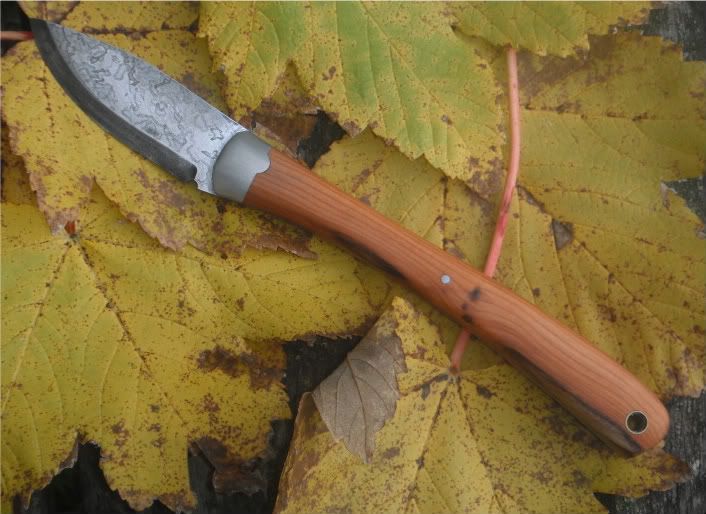
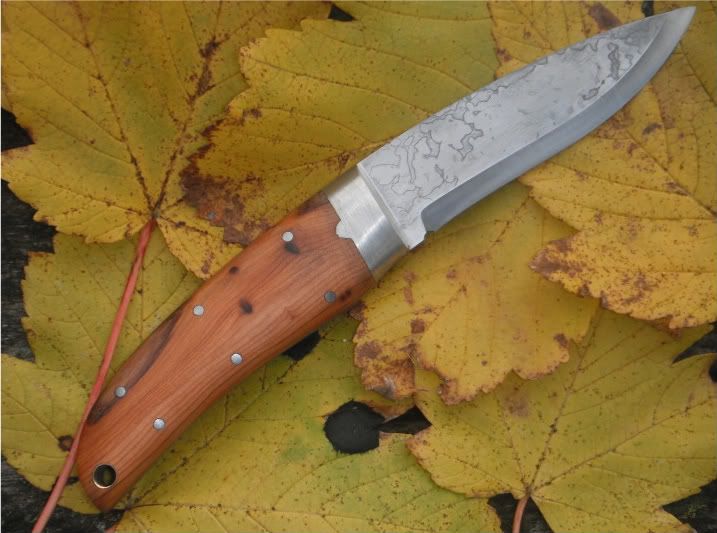
To go with the new Nessie, I have created another 2 knives. This is the second of the set. The knife is unusual because it has a very long and slim handle. The length is slightly over 8 1/2", a bit longer thaan the Nessie, but the blade is only 2 1/2" long. The reason is that I am growing to like long handle on my knives. I have fairly large hands and I found it easier to manipulate a knife with a long handle.

Tutorial. How to make a pewter bolster
I have written this post to show how I am making the pewter bolsters on some of my knives.
This is the knife I am going to use to make the bolster.
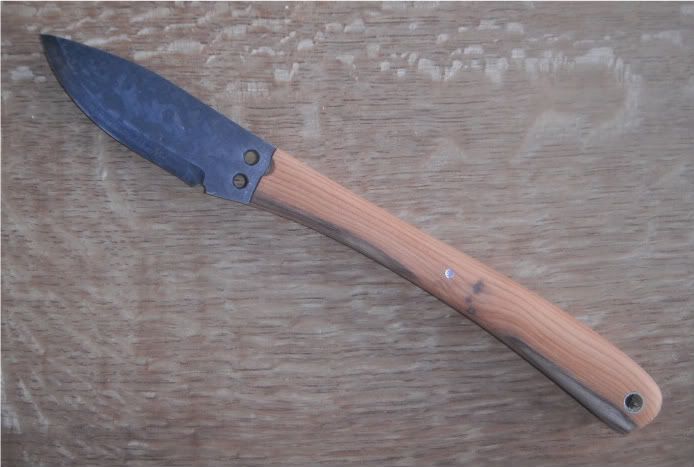
The two holes in the blades are there to anchor the pewter bolter onto the blade. You can see the 1/2 round scallop on the wood part of the handle, this is both to look nice and to hold on to the wood handle. It could be said the holes in the blade will weaken it, but I think the bolster pewter compensates for that.
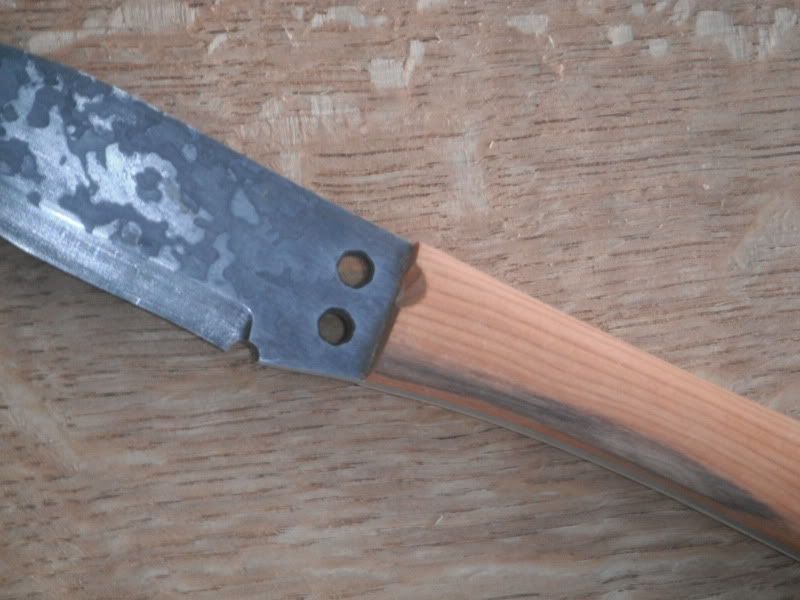
First thing to do is to wrap about 10 turns of masking tape around the handle below the 1/2 round scallop. This compensate for the slight shrinkage when the pewter cools down.
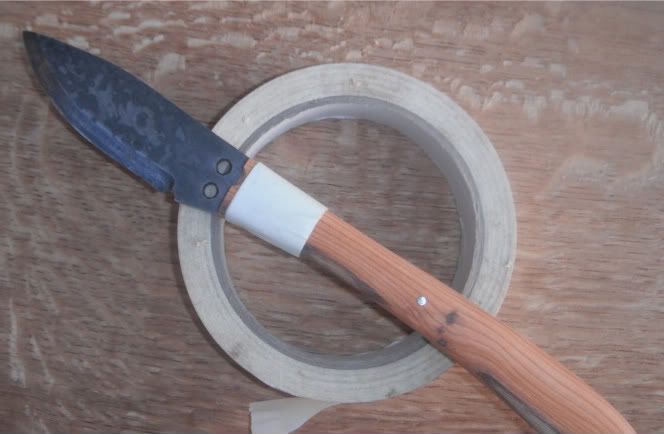
Next, I cut a strip of thin cardboard, the sort of stuff you find on a breakfast cereal box. I wrapped it around the handle, with the top about where I wanted the pewter to end. Then I used masking tape to secure the cardboard to the handle.
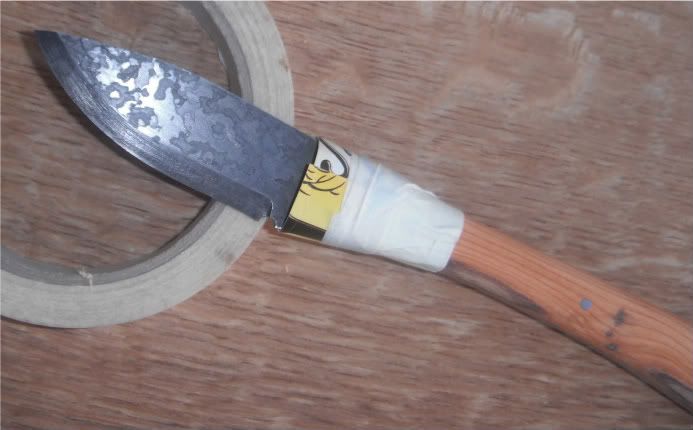
A (poor) view of the well into which the pewter is going to be poured.
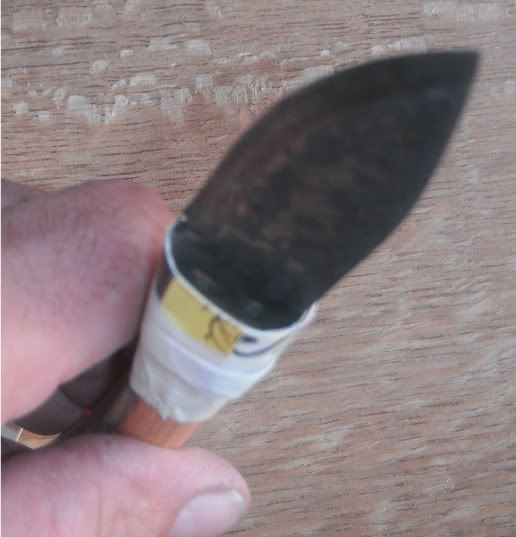
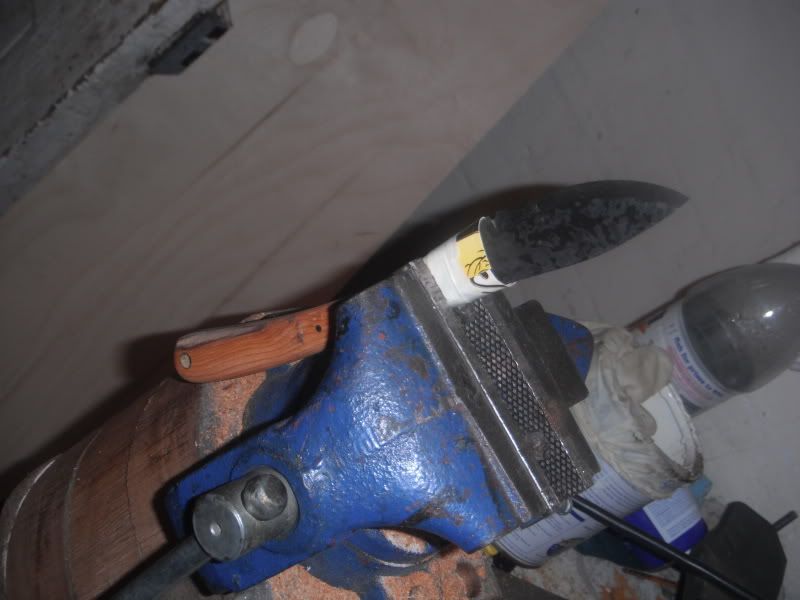
The knife being held in the vice, ready for the pewter to be poured.
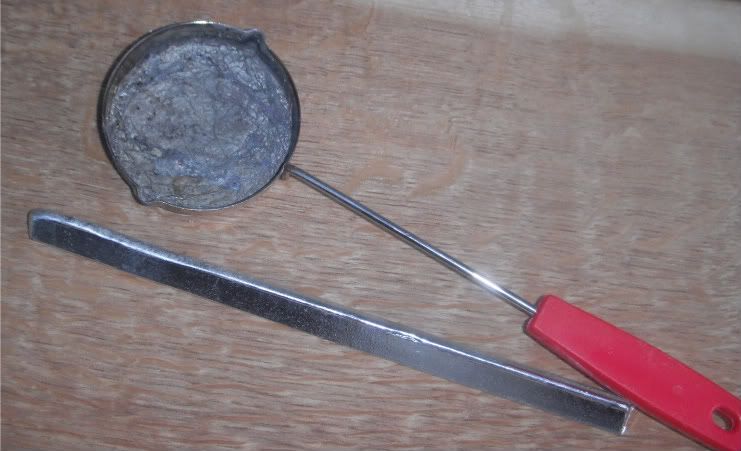
This is the ladle I bought for pouring the pewter. It's not particularly good. Basically, I find it too small and the spouts are also a bit on the short side. It would have been better and cheaper to use a small tin/can and bend a pouring spout onto it. Also on the pic is a bar of pewter. I tried to find some pewter pots and such in second hand shops, to no avail unfortunately, so ended buying some. On the plus side, it's pretty pure pewter with little lead in it.
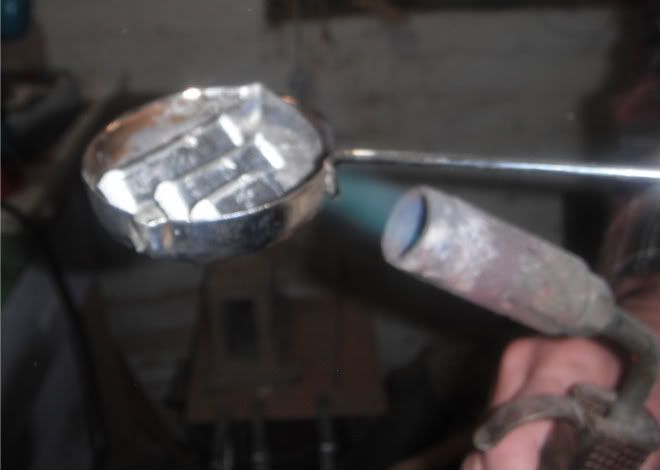
The pewter, chopped up into the laddle and being melted with a blow torch. I made sure to heat it up well, to give a little more pouring time, as it hardens very quickly. Also it is worth warming the blade up, I used a hot air gun. This also add a bit more time, and helps the pewter stick to the blade better. Then I quickly poured the molten pewter in one smooth move into the cardboard well. I was careful here: the molten pewter is VERY hot, and it will spatter droplets all over the place if it fall onto the floor. Not a good idea to do it wearing open toe sandals! Also it is important to make sure everything it completely dry. If there is any moisture anywhere when the pewter is being poured, it will sort of explode all over the place. It is not a good idea.
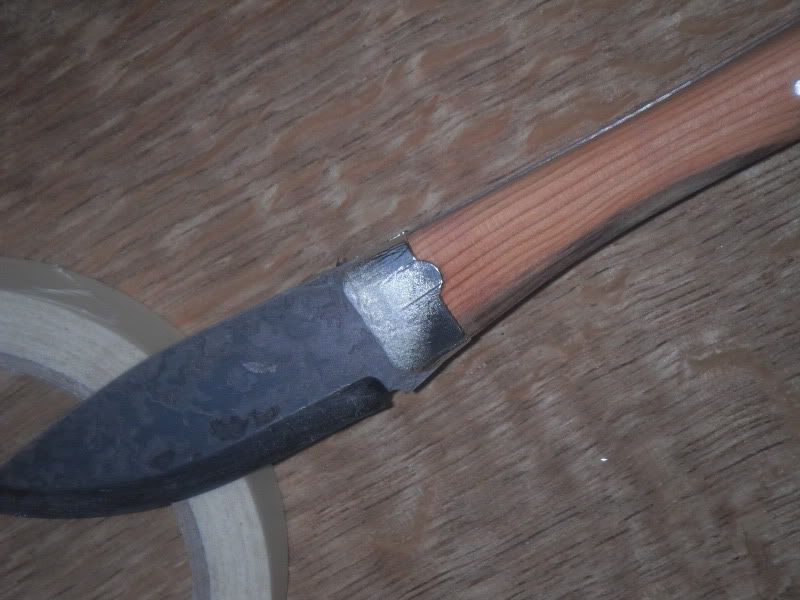
The cooled pewter bolster, fresh out of the cardboard.
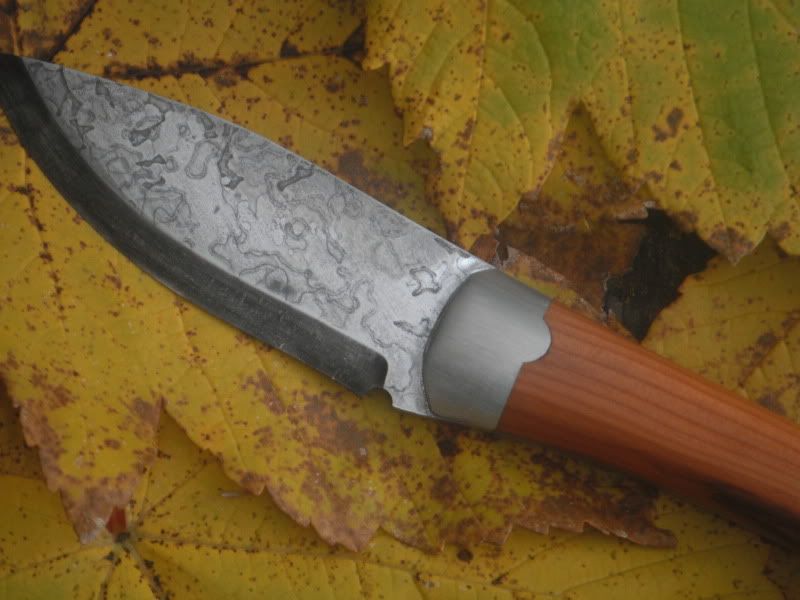
Finally, a picture of the finished bolster. The pewter bolster is easy to finish with hand files and increasingly finer wet/dry sand paper.
This is the knife I am going to use to make the bolster.

The two holes in the blades are there to anchor the pewter bolter onto the blade. You can see the 1/2 round scallop on the wood part of the handle, this is both to look nice and to hold on to the wood handle. It could be said the holes in the blade will weaken it, but I think the bolster pewter compensates for that.

First thing to do is to wrap about 10 turns of masking tape around the handle below the 1/2 round scallop. This compensate for the slight shrinkage when the pewter cools down.

Next, I cut a strip of thin cardboard, the sort of stuff you find on a breakfast cereal box. I wrapped it around the handle, with the top about where I wanted the pewter to end. Then I used masking tape to secure the cardboard to the handle.

A (poor) view of the well into which the pewter is going to be poured.

The knife being held in the vice, ready for the pewter to be poured.

This is the ladle I bought for pouring the pewter. It's not particularly good. Basically, I find it too small and the spouts are also a bit on the short side. It would have been better and cheaper to use a small tin/can and bend a pouring spout onto it. Also on the pic is a bar of pewter. I tried to find some pewter pots and such in second hand shops, to no avail unfortunately, so ended buying some. On the plus side, it's pretty pure pewter with little lead in it.

The pewter, chopped up into the laddle and being melted with a blow torch. I made sure to heat it up well, to give a little more pouring time, as it hardens very quickly. Also it is worth warming the blade up, I used a hot air gun. This also add a bit more time, and helps the pewter stick to the blade better. Then I quickly poured the molten pewter in one smooth move into the cardboard well. I was careful here: the molten pewter is VERY hot, and it will spatter droplets all over the place if it fall onto the floor. Not a good idea to do it wearing open toe sandals! Also it is important to make sure everything it completely dry. If there is any moisture anywhere when the pewter is being poured, it will sort of explode all over the place. It is not a good idea.

The cooled pewter bolster, fresh out of the cardboard.

Finally, a picture of the finished bolster. The pewter bolster is easy to finish with hand files and increasingly finer wet/dry sand paper.

My new Nessie design

I have made many Nessies of various shapes and sizes in the recent past, and never managed to keep one to myself yet! So I decided to make one for me...I'll try to hang on to it, for a while anyway! It's a strange thing, but because I know I can makes knives, I am not so inclined to hang on to them, and If I get an good offer...well, you know...
All my Nessies to date have been closely following Nessmuk's drawings, with the more extreme curve than most bushcrafters are comfortable with regarding knives. I decided to design and make a new knife, unmistakenly Nessie, but which would be a middle ground in abilities between a Woodlore type and a full on Nessie.

It definitely has the Nessie's spirit and good looks. The cutting edge is not as curved as on "normal" Nessies. The handle is also a bit flattened out and a little more chunkie to fit into my hand better. I have used Yew slabs and cast a pewter bolter and because of that, it has a very solid, hefty feel to it, but without being too heavy. The pins are steel and the lanyard tube is brass. To go with the overall style, I would have prefered a steel tube but couldn't find one. The 3mm thick, 01 tool steel blade, is etched.
By being less "extreme" in Nessie design terms, it should be a good all round woodcraft knife. Oz, from Canadian Bushcraft, filmed a video where he shows a different technique for making fuzz sticks, and he uses a normal Nessie to do it. So the Nessie design does works as a general woodcraft knife, not just as a full on hunting/butchering knife, which is why I think this little Nessie will work well.

It needs a little more sanding on the handle and then a bath in boiled linseed oil. And of course, a sheath.
Overall, the Nessie is 8 1/4" long. The cutting edge is just 4" long.
An update on my tablet weaving
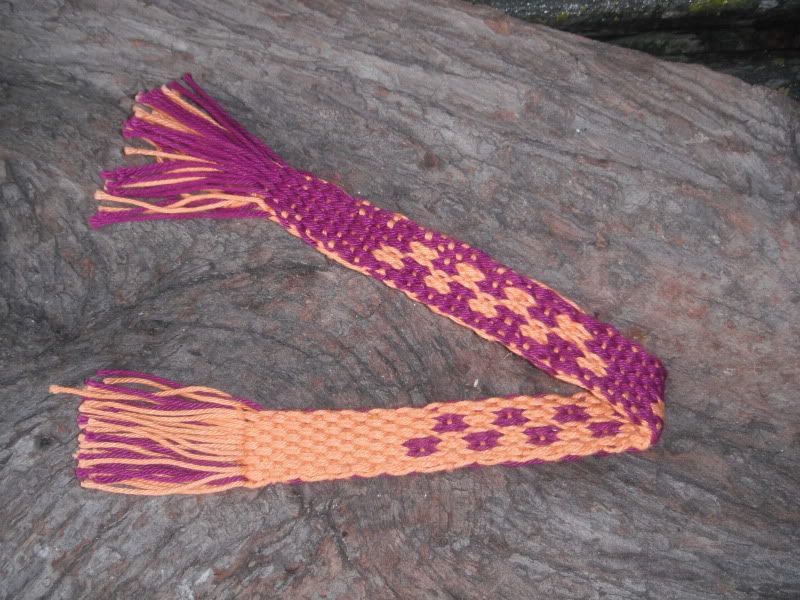
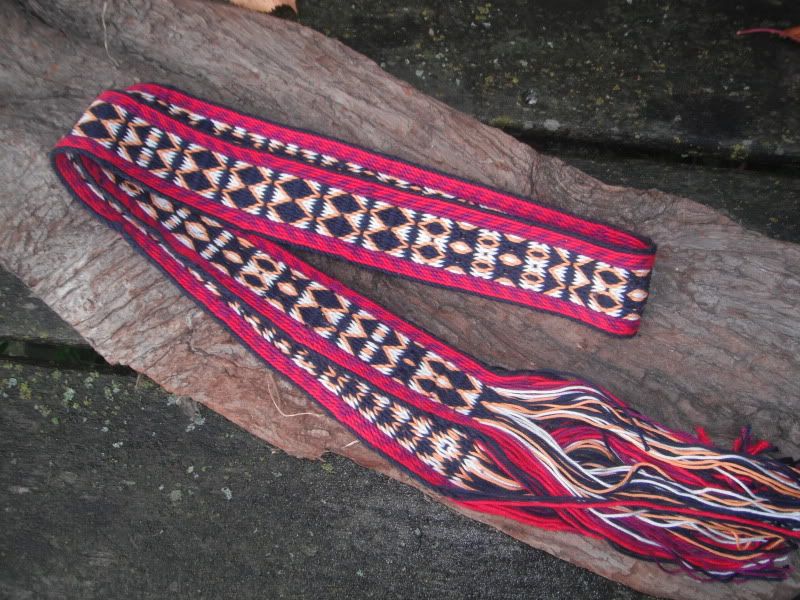
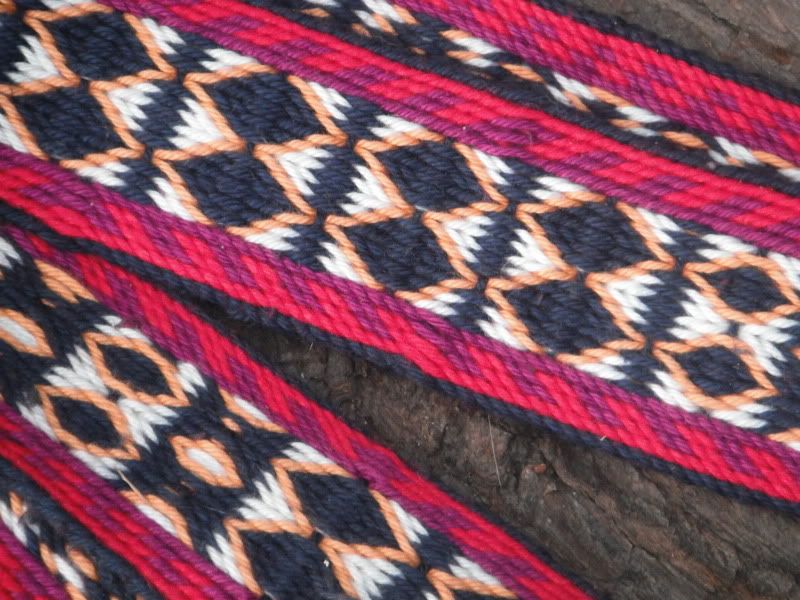
Well, I have persevered with the tablet weaving and finished my first strap. It's 2" wide and 4ft long. I am very happy with it as my first proper attempt at making something useful with weaving. I am going to use it to make the strap for a possible's/hunting bag, sort of mountaiman-ish! I have also made my first sample of double faced weaving. I am also happy with that because I have learned a lot from making those and I will continue tablet weaving. Here are a couple of pictures.
Here's the double-faced sample. It's a very simple design, designed by me! But it's was enough to help me understand how it works

This is the strap I am going to use for the bag. There are a few hiccups in the pattern, but it's barely noticeable, and I am very happy with it regardless!

Here's the double-faced sample. It's a very simple design, designed by me! But it's was enough to help me understand how it works

This is the strap I am going to use for the bag. There are a few hiccups in the pattern, but it's barely noticeable, and I am very happy with it regardless!

Subscribe to:
Posts (Atom)